
You have decided you want to learn to code. You open a search engine, type “how to start programming,” and suddenly you are hit with a wall of acronyms, fierce debates on developer forums, and a list of hundreds of different syntax options.
It is completely normal to feel entirely overwhelmed before you have even written your first line of code. The anxiety of picking the “wrong” language prevents countless beginners from ever starting. The truth is, picking your first coding language is not an irreversible choice. The developer world expects you to adapt and hop between tools as needed.
That is why new developers often hesitate to pick up a programming language, fearing they will waste time and energy learning something they will never use. In reality, there is no such thing as picking the “wrong” language. No matter which language you choose, you will still be learning valuable skills.
What are programming languages?
Programming languages are the tools used to write instructions that computers follow. Computers think in binary, and programming languages help translate 1s and 0s into code that is much easier to read and understand. This way, programmers act as the link between human ideas and computer operations.
Programming languages may look different on the surface, but they have a lot in common. They share similar patterns and structures, and by learning one language, you’ll be introduced to key coding concepts that’ll help you learn other languages in the future. Once you pick up your first programming language, no matter which you choose, it’ll be easier to pick up others.
Is it Possible to Choose the “Wrong” Programming Language?
The secret that experienced software engineers know is this: when you learn your first programming language, you are actually just learning how to think logically.
Rather than worrying about which language to choose, your priority should be to understand the fundamentals of any programming language. Think of it like setting up a smart home routine. You do not need to know how the electricity actually flows through the wires; you only need to know how to set the rule: “If the time is 7:00 AM, turn on the lights.” It’s that simple.
An advanced programming language is a vast toolkit you could use to write thousands of those logical rules to create and run a smart home routine application like that. Here, you are learning how to store information (variables), how to make decisions (conditionals), and how to repeat actions efficiently (loops).
These core concepts are nearly universal across all modern programming. Learning your first language is like learning to drive a manual car; once you understand the clutch and the gears, switching to a different make or model requires a little adjustment, but you already know how to drive.
Why There’s No Such Thing as the “Wrong” Choice
The fear of wasting time on an irrelevant skill is powerful, but in programming, it is often exaggerated. There is no such thing as backing yourself into a career corner with your first language.
It is common for developers to switch languages multiple times throughout their careers, depending on the project at hand. A senior developer might use Python to write a quick automation script on Monday, and spend Tuesday debugging a complex web application written in JavaScript.
The goal right now isn’t to pick the definitive tool you will use for the rest of your life. The goal is to get familiar with the fundamental mechanics of coding.
Reverse-Engineer Your Choice
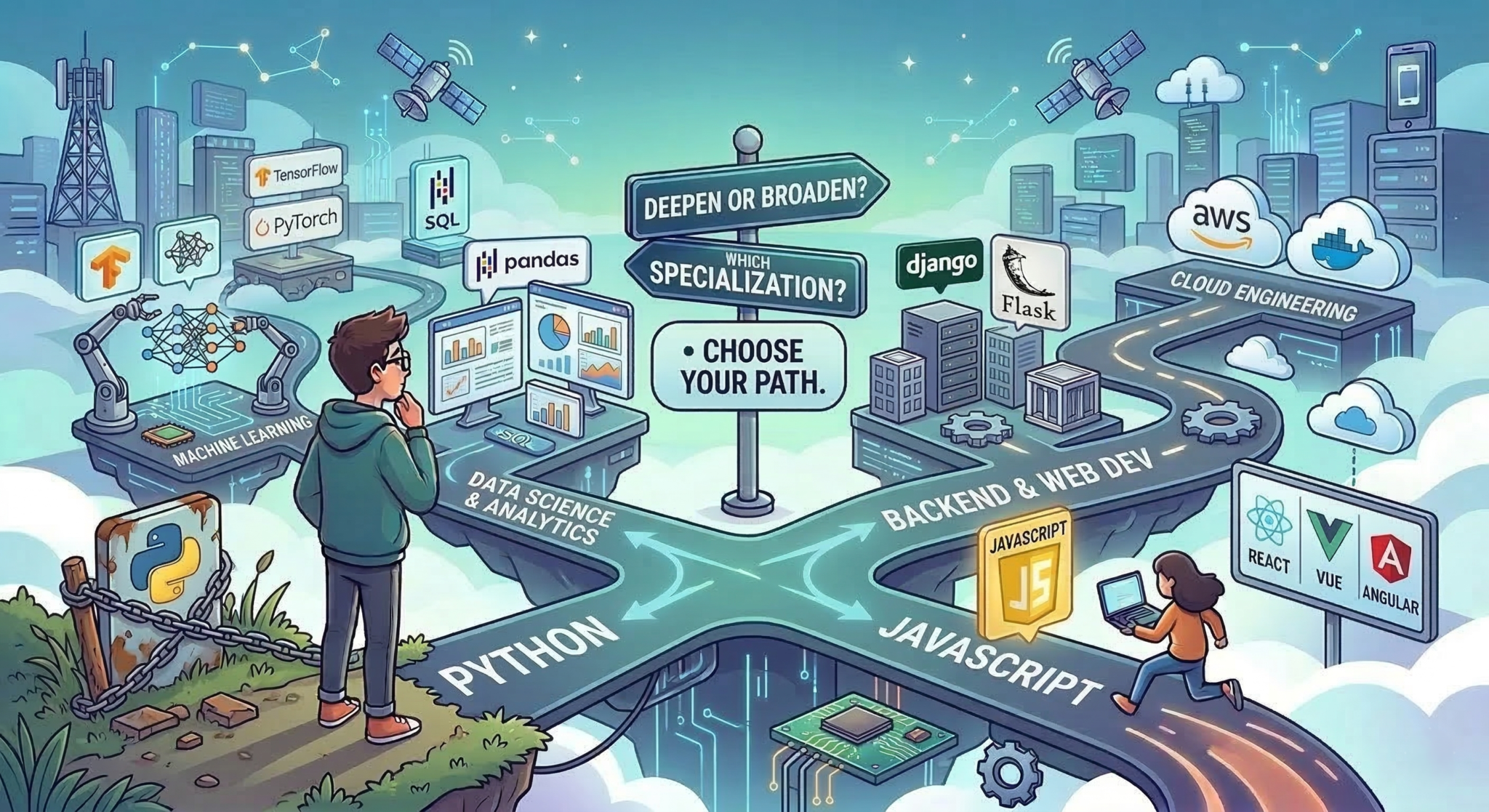
Instead of asking, “What is the best language?” ask yourself, “What do I actually want to build?” Working backward from your end goal is the most practical way to develop and strengthen your skills.
1. Building for the Web (The Frontend)
If you want to build interactive websites, user interfaces, or anything that runs directly in a web browser, your path is relatively strict.
- The Foundation: You must start with HTML and CSS. These are not technically programming languages (they are markup and style languages), but they form the skeleton and the paint of every website on the internet.
- Bringing It to Life (The Logic): Once you understand how to build a static page, you need JavaScript. JavaScript makes things happen—whether that is updating a live shopping cart, animating a menu, or pulling in live weather data. It is the undisputed standard for web interactivity.
2. Automating (The Backend & Data)
For data analytics, artificial intelligence, or scripts that automate repetitive work, the best fit is usually a language that excels at logic and data processing.
- Python: Widely considered the most accessible language for beginners. Its syntax reads remarkably close to plain English, lacking the dense punctuation of older languages. It is heavily used in everything from training machine learning models to writing backend server logic.
- SQL: Often overlooked by absolute beginners, SQL (Structured Query Language) is essential if you want to work with data. It is the universal method for asking specific questions of massive databases—crucial for anyone looking at data analytics or backend software engineering.
3. High-Performance and Game Development
To build complex 3D video games, high-frequency trading platforms, or desktop software that demands maximum performance, you will need languages that give you direct control over the computer’s hardware.
- C++ & C#: These are heavy-duty, industrial-strength languages. C# is the primary language used in the Unity game engine (which powers thousands of indie and mobile games). C++ is famous for its speed and is the backbone of the Unreal Engine, as well as many operating systems and graphics drivers. They have a steeper learning curve, but the payoff in performance is massive.
Every language has its own strengths and frustrations. If you are learning purely for fun and want to see immediate results, JavaScript combined with some basic HTML is a fantastic sandbox. For building logical tools, working with data, or learning AI, Python is a brilliant and highly readable starting point.
The only “wrong” choice is letting the abundance of options prevent you from starting. Pick a language, find a beginner tutorial, and commit to understanding the basics. The rest will follow naturally.