
The history of human progress is defined, in practice, by our collective panic over discoveries or technologies. When the first motor cars appeared in the United Kingdom during the latter part of the 19th century, the Locomotive Act of 1865 required a man to walk ahead of the vehicle waving a red flag to warn the public of the impending danger.
Critics at the time seriously argued that the human body would physically disintegrate at speeds exceeding 14 mph. Many believed it, and that belief turned into fear, even though the 14 mph speed limit was nowhere near enough to make or kill someone, as they believed. The same goes for the invention of TV, calculators, and, more recently, the rollout of 5G infrastructure, which was met with rampant conspiracy theories regarding public health.
Today, it’s artificial intelligence. Spend a few minutes online, and you’ll immediately come across headlines like AI is coming for your job, AI is coming for everything, or warnings about the total collapse of the modern education system.
The idea that AI will take over the world and make human thinking obsolete is not true. There is a good reason people feel worried, and it is completely normal to feel that way. Fear is a natural human survival instinct.
Many believe that relying on and using AI in school will make students “dumb.” To a certain extent, this is true. If a student uses a generative model to write an essay from scratch or solve a complex calculus equation without reviewing the method, they are bypassing the mental effort required for real learning.
However, we need to look beyond the negative assumptions and focus on the benefits of AI. It can give students personalised help at any time, explain difficult academic language, and help them test their own ideas. If you think using AI will make you less intelligent, that is not true. In fact, the opposite is often true. If you refuse to use it or do not learn how to use it properly, you may fall behind others in exams and later at work.
Here is a guide on how to leverage Artificial Intelligence to excel in your academic and work life, while maintaining your intellectual integrity and continuing to grow your skills.
Use AI as a Learning Tool, Not a Shortcut
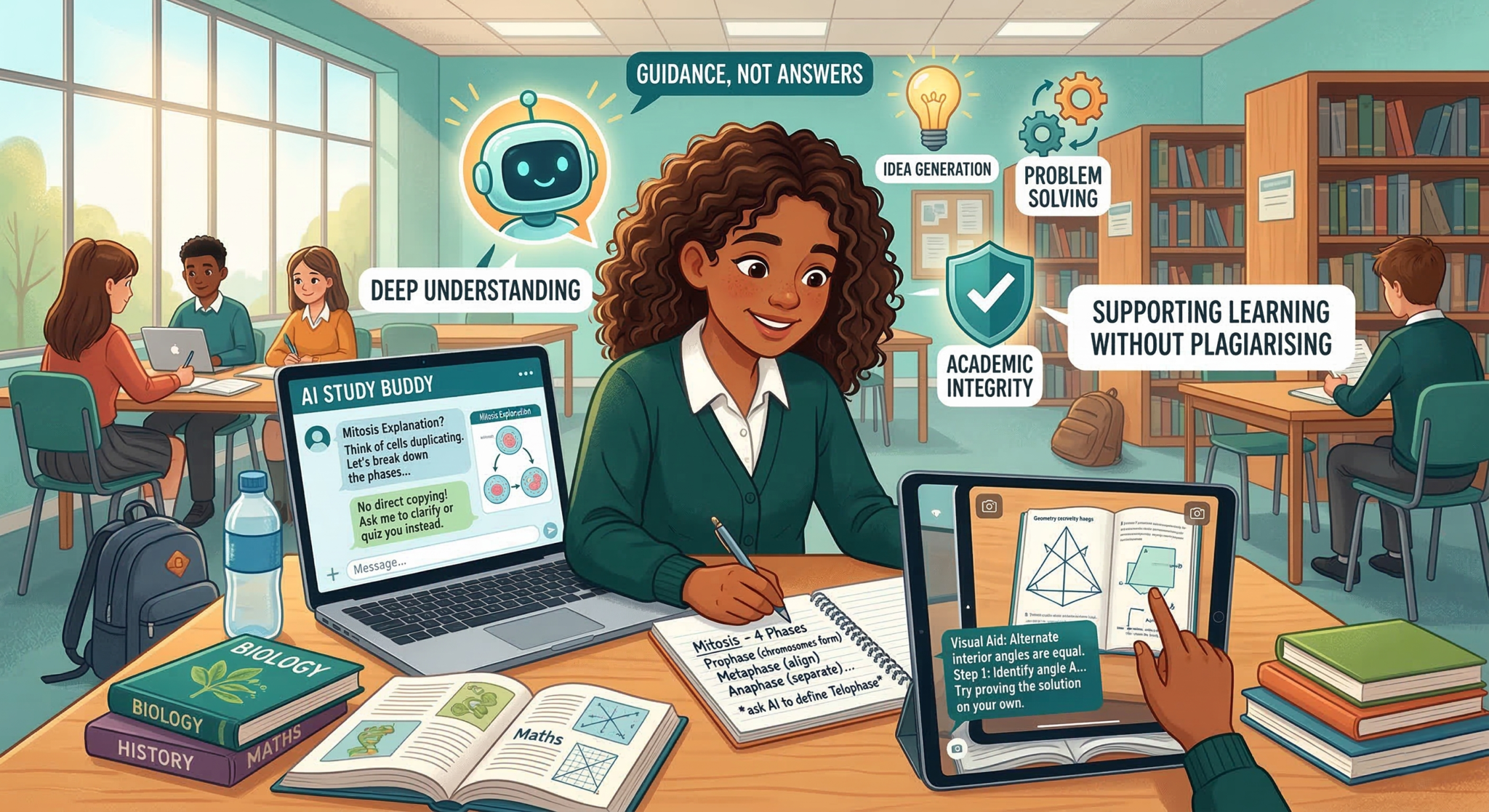
One of the biggest mistakes students make is using AI simply to get answers rather than to think more clearly. Tools such as ChatGPT and Gemini should be seen as helpful, knowledgeable study partners rather than machines that do the work for you.
When you get stuck, the goal should not be to ask AI to finish the task. Instead, you should use it to help you generate ideas, make new connections, and build your understanding step by step. Generative AI is particularly useful for taking a basic idea and developing it into a wide range of possible directions.
For example, if you are struggling to come up with a project idea for a computer science module, you could ask the AI to suggest a range of open-ended, real-world problems that could be solved through coding.
Try this prompt:
I am studying the macroeconomic impacts of inflation, but I am finding the textbook explanations too abstract. Can you explain the core concepts to me using the analogy of managing a local bakery? Also provide three self-test questions at the end.
And that is exactly how it should be. When you prompt AI, you are in control. It responds to your instructions, and it is then your responsibility to assess the response, keep what is useful, and decide what works best for you.
Andvance AI Interaction
Technology has transformed the way we study, use computers, and search for information online. We have moved well beyond the days of simply typing questions into Google Search. With the introduction of Gemini Live and ChatGPT’s Advanced Voice Mode, interacting with AI now feels far more natural and conversational.
Another helpful feature of AI for students today is visual input. If you are struggling with a handwritten geometry proof or a detailed biology diagram, trying to explain it all in words can be intense and frustrating. Now, you can simply use your camera to show the AI what you are working on. It can examine your method, understand the problem visually, and provide helpful feedback without just giving you the final answer. Try the following prompt: switch to live mode and turn on your camera.
Prompt:
This is a complex algebraic equation. I am stuck on the third line of my working out. Do not give me the final answer; instead, look at my logic and tell me which mathematical rule I have failed to apply.
Write the Program Yourself, Let AI Support the Process
When learning to code, the biggest mistake students make is using AI to generate entire programs/solutions instead of using it to strengthen their understanding. A good practice is to use AI to support the learning process, not replace it.
Programming is not just about producing working code. It is about understanding how and why the code works. Concepts such as variables, loops, conditionals, and functions appear across many programming languages, but each language expresses them in different ways. AI can be especially useful when you understand the logic in one language but struggle to apply it in another.
Rather than asking AI to complete a full task for you, use it to clarify ideas, explain unfamiliar syntax, and help you recognise patterns between languages. It can break down difficult concepts, show you equivalent structures, and guide you through the reasoning behind each step. This allows you to stay in control of the work while building real confidence in your coding ability.
For example, if you already understand how a for loop works in JavaScript but are finding C++ confusing, you can ask AI to compare the two and explain the differences clearly. In this way, AI becomes a learning aid that helps you think more effectively, rather than a shortcut that does the thinking for you.
Try this instead:
I understand how to write a for loop in JavaScript, but I am currently learning C++. Can you show me the equivalent structure in C++ and explain the reasons for the differences in syntax?
Digital Tools to Support Your Learning
To maintain a competitive edge, students must move beyond general-purpose applications and use specific tools designed for different academic tasks.
- Wolfram Alpha: The definitive standard for mathematics and the advanced sciences. Unlike standard generative models, Wolfram relies on computational logic and structured data, making it virtually immune to generating false or “hallucinated” mathematical results.
- Perplexity AI: A powerful research tool. It searches the live internet and provides inline citations and footnotes for every factual claim it makes, allowing you to trace information back to primary and secondary sources.
- Notion AI: An exceptional organisational tool. Notion can take a disorganised page of lecture notes and quickly turn it into a clear, well-structured set of notes in seconds.
- Grammarly: Moving far beyond basic spell-checking, Grammarly’s advanced tone-detection algorithms ensure that your academic writing maintains an objective, formal, and persuasive voice.
8 Platforms to Level Up Your Career
Relying solely on your school’s curriculum is no longer sufficient. To genuinely future-proof your career and technical proficiency, you must engage with external, AI-integrated learning environments. These six platforms represent the absolute pinnacle of online education:
- Codecademy: An industry leader for interactive programming. Their embedded AI Learning Assistant evaluates your specific lines of code. When you make an error, it acts as a mentor, explaining the underlying logic flaw rather than simply autocorrecting the text.
- W3Schools: An indispensable resource for anyone studying web development. It is highly accessible, rigorously structured, and serves as the most reliable quick-reference documentation for HTML, CSS, JavaScript, and backend languages.
- FreeCodeCamp: A remarkable, non-profit platform providing thousands of hours of rigorous curriculum in software engineering, data science, and machine learning, entirely free of charge.
- Udemy: The optimal platform for acquiring highly specific, project-based technical skills. Whether you need to master advanced Excel macros, Adobe Suite, or specific AI prompt engineering, Udemy offers targeted, professional instruction.
- Coursera: Ideal for students seeking university-grade rigour. It offers modules from elite institutions such as Stanford and Yale, allowing you to earn professional certificates that carry significant weight on a CV.
- Khan Academy: The most dependable platform for foundational subjects. Their bespoke AI tutor, “Khanmigo,” is specifically engineered with strict guardrails to never provide direct answers, making it a highly ethical, teacher-approved study companion.
- edX: A strong choice for students who want access to courses and certificates from major institutions. It offers flexible online learning from organisations such as Harvard, MIT, Cambridge, Google, and Amazon, along with verified certificates that can be used to demonstrate achievement.
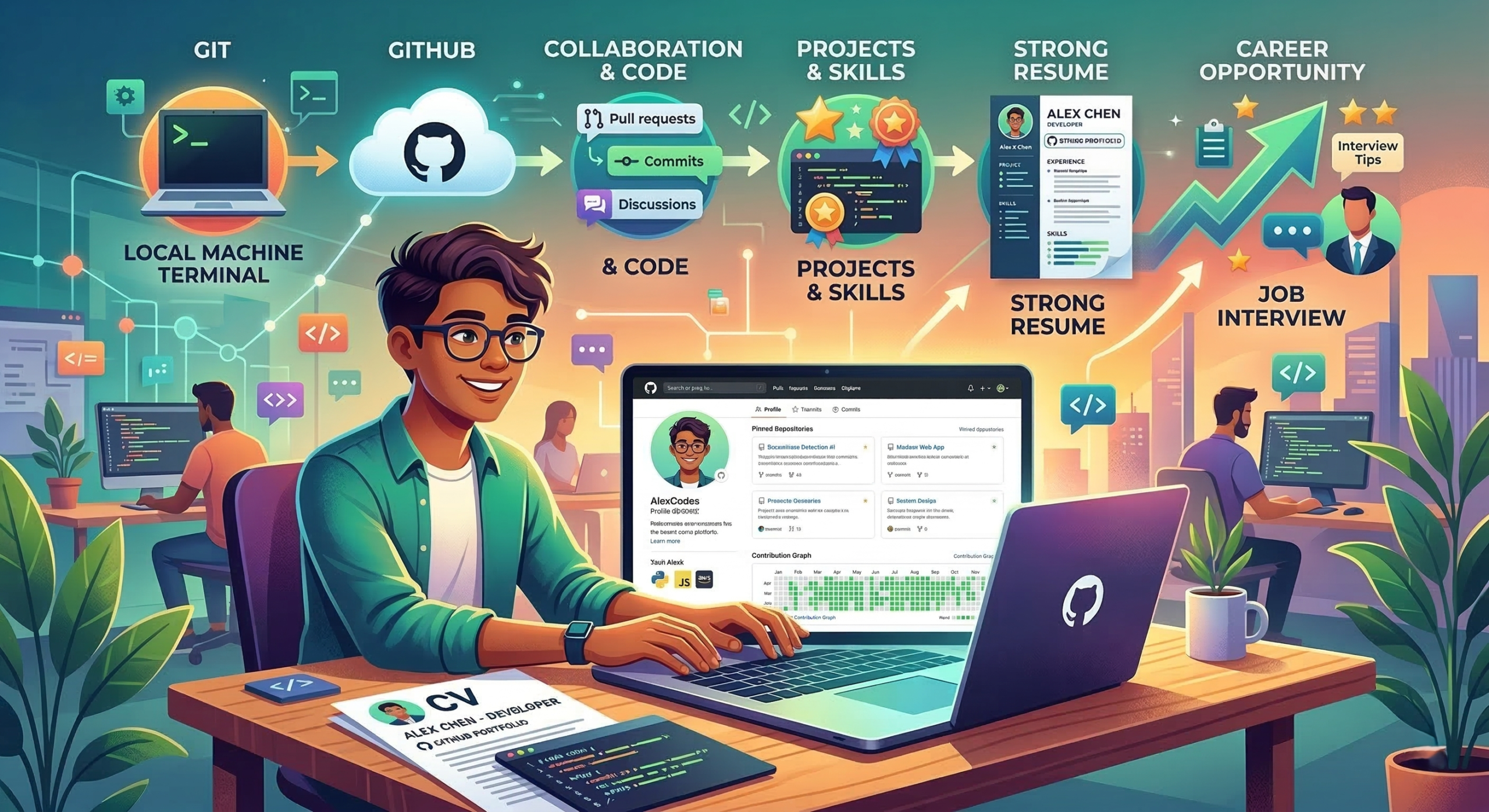
- LinkedIn Learning: Yes, LinkedIn! It’s a powerful platform for professionals and students who want career-focused skill development. Its Learning Paths and programming courses are well-suited to learners who want to build practical knowledge in areas such as software development, Python, Java, and C++, while also keeping their learning aligned with employability.
So, if you wish to demonstrate to future employers and university admissions boards that you understand the practical applications of this technology, you must look outside the classroom.
You may also want to consider applying for structured programmes such as the Mark Cuban Foundation’s AI Bootcamp. They offer students the opportunity to learn directly from industry professionals and build capstone projects that utilise AI to solve real-world problems.
AI in education will make a clear difference between students who use it well and those who do not. Students who only use it to cheat or copy work will struggle later on, especially in jobs that require independent thinking and real problem-solving.
But students who use AI to improve their ideas, stay organised, and get help with learning will put themselves ahead. Use it wisely to support your learning, and you will stay ahead of the competition.