
We often think of programmers as individuals with extraordinary minds, typing at great speed to solve complex problems and somehow knowing every software framework ever developed. Someone like this does not exist and probably never will.
The vast majority of seasoned developers are not born with a special ability to recall everything. They do not have the entire syntax of Python, JavaScript, or C++ memorised. What they do have is the habit of constantly searching for solutions, relying on development environments to autocomplete their code, and frequently consulting their peers.
This systematic, creative, and resilient way of learning allows them to approach any task with confidence. That is why they can break seemingly vast and disordered problems down into clear, logical, and elegant solutions—it is a skill developed through practice.
Understand the Problem
When you’re building software, your goal is to design a logical set of instructions that a machine can execute to achieve a specific outcome.
But before you can create a solution, you must first understand the problem. You cannot solve a problem you do not understand. That is why the programmer’s mindset is rooted in three essential habits:
- Understanding foundational structures (the logic, the flow of data, the conditions).
- Applying these structural principles creatively to completely new environments.
- Knowing precisely how and where to source the technical specifics you do not currently have memorised.
When you stop trying to memorise everything and start focusing on how to solve problems, you are beginning to think like a programmer.
Programmer vs Non-programmer
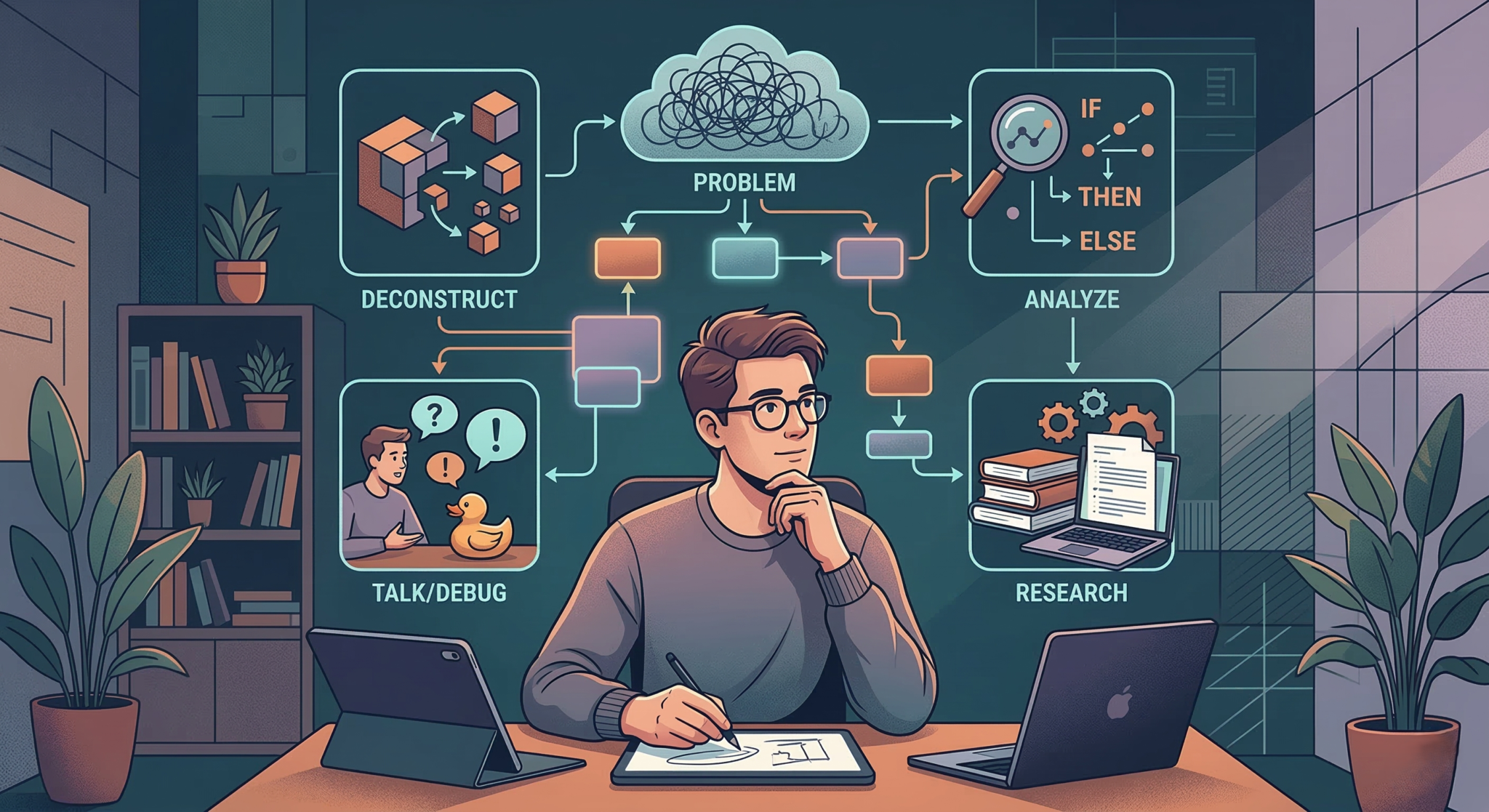
To achieve any result, there is one non-negotiable technique you must master: breaking large, monolithic problems into small, solvable actions.
How would a programmer approach a simple, everyday task like making a perfect cup of coffee?
A non-programmer might instruct a machine with a single prompt: ‘Make a cup of tea.’ But that instruction is a monolith—far too abstract, implying dozens of complex, nuanced actions that a machine with zero contextual awareness cannot interpret. A programmer, on the other hand, would approach the task through rigorous deconstruction. They would take the abstract monolith and translate it into an algorithm:
- Input verification: Check that the kettle, water, teabag, and mug are present.
- Condition 1: Measure the water level in the kettle. If the volume is below 250ml, add water until it reaches 500ml.
- Action: Switch on the kettle.
- Loop: Wait for the water to boil. Continue checking until the temperature reaches 100°C.
- Action: Place the teabag into the mug.
- Action: Pour exactly 250ml of hot water into the mug.
- Timer: Start a 180-second countdown.
- Action: Once the timer ends, remove the teabag.
- Output: The tea is ready for consumption.
Notice how this systematic breakdown transforms a vague command into a precise, reliable sequence of actions. Each step is small, logical, and easy to execute.
This is the central superpower of a software developer. Through rigorous practice, they learn to instinctively look at a massive, intimidating challenge and break it down into smaller, manageable components that can be solved one step at a time.
8 Ways to Start Thinking Like a Programmer
To think like a programmer, you must learn to approach problems differently. The following methods will help you develop that mindset.
1. Start Small, Then Expand
Before you ever attempt to write a line of code or tackle a large project, step back. Do not try to solve the entire project at once. Instead, identify the smallest possible components of the task. Sketch out the logic on a whiteboard or a piece of paper using plain English, often called pseudocode.
Clarify the ‘if this happens, then do that’ pathways. Once the underlying algorithm is solid, translating it into a specific programming language becomes far easier. You gain momentum by solving small, isolated problems, which gradually combine into a large, cohesive system.
2. Avoid Perfection on the First Attempt
When faced with a complex build, never try to engineer the perfect final version on your first attempt. That is a guaranteed recipe for burnout. Instead, ask yourself: ‘What is the most basic, stripped-down version of this system I can build to prove the concept?’ Build that Minimum Viable Product (MVP). Get it working. Then, and only then, introduce a single new layer of complexity. Test it. Add another. This iterative process manages risk and ensures constant, visible progress.
3. Apply Rubber Duck Debugging
When you hit a wall, your thought process often becomes circular and trapped. To break this cycle, you must externalise the problem. Explain your objective out loud, step by step.
In the tech industry, this is famously known as ‘Rubber Duck Debugging’—developers will literally explain their code to a toy duck on their desk. By forcing your brain to translate abstract thoughts into structured, spoken language, you will often identify the logical flaw before you have even finished your sentence.
4. Embrace the Detective Mindset
Errors and bugs are not failures; they are feedback mechanisms for progress. It is easy to become frustrated when a system breaks down, but a programmer’s instinct is to detach emotionally and become a forensic detective. What was the expected behaviour? What was the actual behaviour? Isolate the variables. Test each component individually.
This method of identifying the root cause of a problem is valuable in nearly every professional environment. Employers are not only looking for developers who can build new applications; they are also seeking people who can diagnose problems, debug errors, and patch systems.
5. Read Documentions
If your software is a skyscraper, the official documentation is the architectural blueprint. The most effective developers do not rely on guesswork or hacky shortcuts; they are experts at navigating technical documentation.
Learning to read these manuals ensures you understand exactly how the creators intended a tool to be used. This habit builds a rock-solid, foundational understanding that results in robust, highly efficient work.
6. Prioritise Understanding Over Memorisation
Trying to memorise syntax is one of the least effective ways to learn programming. Real progress does not come from passively reading or memorizing endless rules; it comes from using them. The programmer’s mindset is built through practice, repetition, and problem-solving.
Every time you create something real, especially when it challenges you, you deepen your understanding. Instead of trying to memorise how a data structure works, build a small project that forces you to apply it in context.
7. Collaborate with Other Developers
Building a high-level project is rarely a solo effort. Strong developers actively seek feedback because they understand the value of a fresh perspective. Working with others, especially through collaborative exercises such as sharing one screen to solve a problem or reviewing code on GitHub, helps expose blind spots, sharpen logic, and improve decision-making. One person can guide the reasoning while the other writes the code, with roles switching regularly. Seeing how someone else approaches the same challenge expands your own thinking and makes you a more adaptable problem-solver.
8. Learn by Building
You cannot learn to ride a bicycle by reading physics textbooks, and you cannot learn to programme solely by watching tutorials. Active construction is non-negotiable. Rote memorisation is passive and easily forgotten. True understanding is forged through the friction of building real things, breaking, and fixing them.
Every time you build a small project, even something as simple as a digital calculator or a to-do list, you strengthen the neural pathways behind algorithmic thinking. Practice is the only bridge between theoretical knowledge and practical mastery.
Putting Your Mental Framework into Practice
Developing the programmer mentality is a journey of continuous, lifelong learning. If you are eager to begin practising these structural techniques, there are countless ways to start forging your own programming perspective.
- Seek out professional development courses focused on systems thinking, logic, and algorithmic design.
- Start designing simple personal projects, even analogue ones, where you force yourself to plan the entire workflow before taking the first step.
- Engage with a community of builders and creators to observe how others handle their challenges.
As a programmer, you can never build a perfect program on your first attempt, not even if you are an expert. Code will always break, and there will always be problems to fix. That is the circle of programming: think, build, break, debug, repeat. This mindset is the foundation that will shape you throughout your career.