
You have decided you want to learn to code. You open a search engine, type “how to start programming,” and suddenly you are hit with a wall of acronyms, fierce debates on developer forums, and a list of hundreds of different syntax options.
It is completely normal to feel entirely overwhelmed before you have even written your first line of code. The anxiety of picking the “wrong” language prevents countless beginners from ever starting. The truth is, picking your first coding language is not an irreversible choice. The developer world expects you to adapt and hop between tools as needed.
What are programming languages?
Programming languages are the tools used to write instructions that computers follow. Computers think in binary, and programming languages help translate 1s and 0s into code that is much easier to read and understand. This way, programmers act as the link between human ideas and computer operations.
Programming languages may look different on the surface, but they have a lot in common. They share similar patterns and structures, and by learning one language, you’ll be introduced to key coding concepts that’ll help you learn other languages in the future. Once you pick up your first programming language, no matter which you choose, it’ll be easier to pick up others.
It’s just like learning to drive a manual car; once you understand the clutch and the gears, switching to a different make or model requires a little adjustment, but you already know how to drive.
Think Like a Programmer
Rather than worrying about which language to choose, your priority should be to understand the fundamentals of any programming language. Think of it as setting up a smart-home routine. You do not need to know how the electricity actually flows through the wires; you only need to know how to set the rule: “If the time is 7:00 AM, turn on the lights.” It’s that simple.
An advanced programming language is a vast toolkit you could use to write thousands of those logical rules to create and run an application like that. Here, you are learning how to store information (variables), how to make decisions (conditionals), and how to repeat actions efficiently (loops).
Why There’s No Such Thing as the “Wrong” Choice
The fear of wasting time on an irrelevant skill is powerful, but in programming, it is often exaggerated. There is no such thing as backing yourself into a career corner with your first language.
It is common for developers to switch languages multiple times throughout their careers, depending on the project at hand. A senior developer might use Python to write a quick automation script on Monday, and spend Tuesday debugging a complex web application written in JavaScript.
That’s why new developers often hesitate to pick up a programming language, fearing they will waste time and energy learning something they will never use. There is no such thing as picking the “wrong” language. No matter which language you choose, you will still be learning valuable skills. The only “wrong” choice is letting the abundance of options prevent you from starting.
What programming language should I learn?
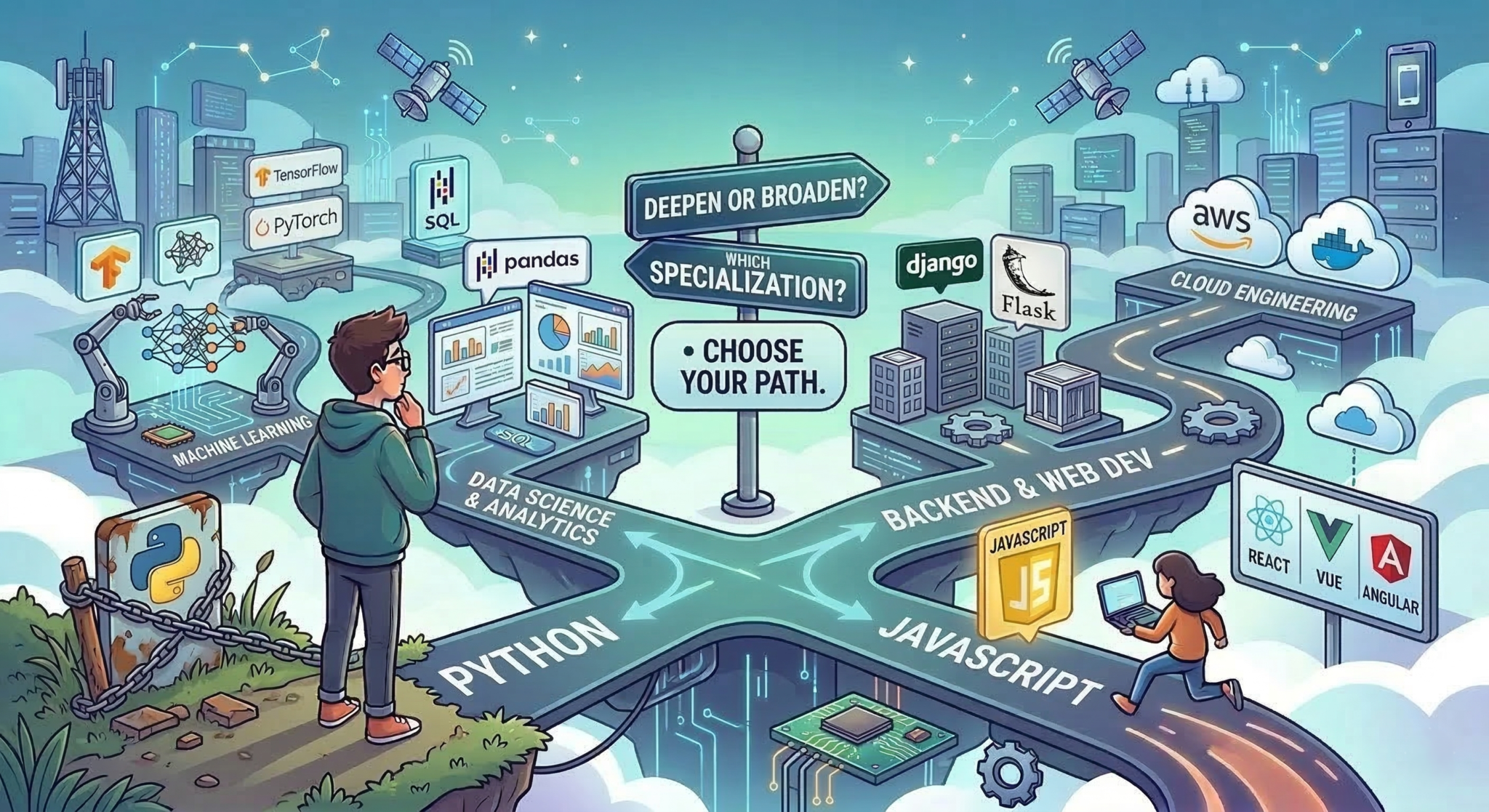
Now that you have some background, it is time to decide which programming language to choose. There are a couple of routes you can take when making this decision: you can choose a language based on your goal, or you can choose one based on what is most in demand or popular in the industry.
Reverse-engineer your choice: There are thousands of programming tools and libraries out there to choose from. Ask yourself: Why do you want to learn a programming language? Are you learning just for fun? Are you curious about what coding is like? Or are you trying to build something specific or get a new job? Answering these questions is a great way to figure out what language is best to start with. But if it is just for fun, pick any language you like.
1. Building for the Web (The Frontend)
If you’re at the very beginning of your coding journey and want to build interactive websites, user interfaces, or anything that runs directly in a web browser, your path is relatively strict.
You must start with HTML and CSS; it’s not negotiable. These are not technically programming languages (they are markup and style languages). These two are essential to front-end web development and can be used to structure and design attractive web pages with interactive elements.
Learning HTML and CSS is an excellent starting point for those who want to build websites from the ground up. Once you’re familiar with HTML/CSS and understand how to build a static page, you can move on to JavaScript and libraries like React, which make things happen, whether that is updating a live shopping cart, animating a menu, or pulling in live weather data. JavaScript is the undisputed standard for web interactivity, and React is one of the most widely used libraries for building interactive front-end interfaces.
However, if you want to level up your web development skills and are interested in building traditional web applications, you may want to look into PHP. It is a cornerstone of web back-end development and is commonly used to generate dynamic page content from databases, often with SQL. Keep in mind that you’ll need to showcase a diverse portfolio of your past projects to become a Web Developer.
2. Automating the Backend and Data
For data analytics, artificial intelligence, or scripts that automate repetitive work, the best fit is usually a language that excels at logic and data processing.
- Python: Widely considered the most accessible language for beginners. Its syntax reads remarkably close to plain English, lacking the dense punctuation of older languages. It is heavily used in everything from training machine learning models to writing backend server logic.
- SQL: Often overlooked by absolute beginners, SQL (Structured Query Language) is essential if you want to work with data. It is the universal method for asking specific questions of massive databases—crucial for anyone looking at data analytics or backend software engineering.
Ruby for Backend Development
While it is a general-purpose language (meaning you can technically use it for many different tasks), Ruby is almost always discussed alongside its most famous web framework: Ruby on Rails.
- The Backend Engine: If frontend languages like HTML, CSS, and JavaScript build the buttons and layout you see on a screen, Ruby operates behind the scenes. It handles the heavy logic, communicates with databases, and processes things like user authentication or shopping cart checkouts.
- Rapid Prototyping: Ruby is famous for being incredibly developer-friendly. Its syntax is designed to be clean and read almost like plain English. When you pair that readable code with the Ruby on Rails framework, you get a massive head start. Rails gives you the core web infrastructure ready to go out of the box, allowing you to skip the tedious setup and focus purely on building custom features.
- Automation and Scripting: Because it is so readable and easy to write, developers and system administrators frequently use Ruby to write scripts that automate repetitive server tasks.
Is it a good starting point?
Absolutely. If your primary goal is to launch a fully functioning, complex web application (like a marketplace, a booking system, or a social network) as quickly as possible, Ruby is an excellent choice. It is the foundational tech behind massive platforms like Shopify, GitHub, and Airbnb.
3. Building a Native
If you are certain that you want to build native applications for specific phone operating systems, then you will need to use different languages, libraries, and tools for each one:
- Swift: Exclusively for iOS (Apple’s platform, including iPhones, iPads, and Macs), Swift is the undisputed standard. It’s concise, modern, and is required for most high-demand iOS developer roles.
- Kotlin: Use this to develop native applications for Android (the world’s most popular mobile operating system). Kotlin is now the preferred language. It is official and interoperable with older Java code, but offers many developer-friendly features.
However, when you want to build cross-platform apps that run on both IOS and Android, you might want to look into JavaScript frameworks like React Native later.
4. High-Performance and Game Development
Some languages are the foundation of major, scalable systems. These require deeper foundational knowledge but are critical for large companies:
To build complex 3D video games, high-frequency trading platforms, or desktop software that demands maximum performance, you will need languages that give you direct control over the computer’s hardware.
- C++ & C#: These are heavy-duty, industrial-strength languages. C# is the primary language used in the Unity game engine (which powers thousands of indie and mobile games). C++ is famous for its speed and is the backbone of the Unreal Engine, as well as many operating systems and graphics drivers. They have a steeper learning curve, but the payoff in performance is massive.
- Java: This is the absolute giant of “enterprise” programming. It is the core language used to build massive, secure, high-performance back-ends for large banks, corporations, and government systems. If you want a job at a Fortune 500 company, Java is often the required skill.
- Go (Golang): A modern language created at Google, Go is designed for simplicity, efficiency, and scalability. It is heavily used in cloud engineering, container orchestration (like Kubernetes), and infrastructure services.
- Rust: For those focused on performance and memory safety, Rust is a great choice. It is being adopted for operating systems, game engines, and critical performance components where security is paramount. It is often cited as the most-loved language in developer surveys, even if its learning curve is steeper.
Why Networking Is Your Best Opportunity for Growth
The code cannot speak for itself. You can memorise every Python library, master React, and build a flawless application, but a perfect portfolio will not automatically hand you a job. In the tech industry, code does not hire people; humans hire humans.
Networking is the most underrated skill you can have, regardless of your field. Even if you know everything there is to know about your chosen field, you still need to network. You need to learn from experts who have already navigated the obstacles you are facing right now. If possible, find someone to mentor you. Having an experienced engineer review your code or offer career advice will accelerate your growth far faster than any online tutorial.
Do not fall into the trap of thinking networking is only for beginners looking for their first break. Even the most seasoned, highly paid senior developers are constantly networking, sharing ideas, and leaning on their peers for technical advice, and you too can do the same.